.jpg)
Few novels have had an influence as profound as Mary Shelley's Frankenstein; or, The Modern Prometheus. (Links are Amazon affiliate links) First published anonymously in 1818, the novel introduced readers to Victor Frankenstein, a young scientist who discovers a way to create life—and then recoils from the creature he has brought into existence.
More than two centuries later, Frankenstein remains one of the most frequently adapted stories in popular culture. The name "Frankenstein" has become synonymous with the monster, even though Frankenstein is actually the name of the scientist.
But the novel is much more than a horror story. It asks fundamental questions about science, responsibility, human nature, isolation, ambition, parenthood, and what it means to be human. It also helped establish many of the themes and conventions that would become central to science fiction.
Who Was Mary Shelley?
Mary Wollstonecraft Shelley was born Mary Godwin on August 30, 1797, in London.
She came from an extraordinary intellectual family.
Her father was William Godwin, an influential philosopher and political radical. Her mother was Mary Wollstonecraft, one of the earliest major advocates for women's rights and the author of A Vindication of the Rights of Woman.
Mary's mother died shortly after giving birth to her, leaving Godwin to raise Mary and her older half-sister.
Mary grew up surrounded by books, intellectuals, political radicals, and writers. This environment was crucial to her development as an author.
In 1814, she began a relationship with the poet Percy Bysshe Shelley, who was already married. Mary and Percy eventually traveled through Europe together.
In the summer of 1816, they stayed near Lake Geneva with the poet Lord Byron and Byron's physician and friend John Polidori.
That summer would change literary history.
The Summer That Created Frankenstein
The summer of 1816 was unusually cold.
The previous year, the eruption of Mount Tambora in Indonesia had produced enormous atmospheric effects. 1816 became known in parts of Europe and North America as the "Year Without a Summer."
Rain and cold weather kept the group indoors for long periods.
At Villa Diodati, Byron proposed that everyone should write a ghost story.
The challenge produced several important works.
Polidori eventually wrote The Vampyre, an important early vampire story.
Mary struggled to think of an idea.
Then she experienced what she later described as a kind of waking dream.
She imagined a scientist creating a living being.
The image became the foundation for Frankenstein.
Mary was only 18 years old when she conceived the story.
She continued developing it after returning to England, and Frankenstein was published in 1818.
What Is Frankenstein About?
The novel begins with the explorer Robert Walton, who is attempting to reach the North Pole.
Walton encounters Victor Frankenstein, who has been pursuing a mysterious creature across the Arctic.
Victor tells Walton his story.
As a young man, Victor becomes fascinated with the mystery of life.
He studies natural philosophy and chemistry and eventually discovers a method for animating dead matter.
Victor constructs a humanoid creature and brings it to life.
But the moment the creature awakens, Victor is horrified by what he has done.
He abandons it.
That decision becomes the foundation of the tragedy.
The creature is not initially evil.
He is intelligent, curious, sensitive, and desperate for companionship.
But he is rejected because of his appearance.
He eventually encounters a family and secretly observes them, learning language and human behavior.
He also reads books, including works that shape his understanding of humanity.
The creature eventually confronts Victor and asks him for one thing: a companion.
Victor initially agrees to create a female creature but ultimately destroys his second creation.
The creature vows revenge.
The resulting conflict destroys both creator and creation.
The Monster Is Not Named Frankenstein
One of the most persistent misconceptions about the story is that Frankenstein is the name of the monster.
It isn't.
Victor Frankenstein is the scientist.
Mary Shelley never gives the creature a personal name.
He is variously described as:
- The creature
- The monster
- The daemon
- The wretch
- The being
The creature's lack of a name is significant.
A name is part of personal identity.
Victor refuses to give his creation one, just as he refuses to accept responsibility for him.
The Major Themes of Frankenstein
The enduring power of Frankenstein comes from its themes.
Mary Shelley was not simply writing a frightening story.
She was exploring some of the most important intellectual questions of her era.
1. Scientific Ambition
Victor Frankenstein wants to discover the secret of life.
His ambition initially seems admirable.
He wants to accomplish something that no human has accomplished before.
But his ambition becomes obsessive.
He stops asking whether he should create life and concentrates only on whether he can.
This has become one of the most enduring interpretations of the novel.
Frankenstein asks:
What happens when scientific capability develops faster than moral responsibility?
That question has become even more relevant in the modern age.
Nuclear weapons, genetic engineering, artificial intelligence, cloning, biotechnology, and other technologies have repeatedly raised versions of the same question.
2. Responsibility for Creation
Victor's greatest failure is arguably not creating the creature.
It is abandoning him.
Victor becomes a creator without becoming a parent.
The creature is born helpless and immediately rejected.
He has no guidance, education, family, or community.
The tragedy therefore raises a question about responsibility:
What obligations does a creator have toward what he creates?
This theme has made Frankenstein remarkably adaptable to modern discussions about technology.
3. Nature Versus Nurture
Was the creature inherently evil?
Mary Shelley does not give us an easy answer.
The creature begins with many positive characteristics.
He wants friendship.
He wants to understand humanity.
He wants to be loved.
Repeated rejection gradually transforms him.
Eventually he becomes violent.
This raises the classic question:
Is evil something we are born with, or can society create it?
The novel strongly suggests that social rejection plays an enormous role in the creature's transformation.
4. Isolation
Almost everyone important in the novel experiences isolation.
Victor isolates himself through his scientific obsession.
The creature is isolated because of his appearance.
Robert Walton is isolated during his Arctic expedition.
The creature's greatest desire is not wealth or power.
It is companionship.
His request for a mate is ultimately a request to no longer be alone.
5. Appearance and Prejudice
The creature's physical appearance determines how people treat him.
People assume that he is evil because he looks frightening.
The creature's experiences therefore illustrate the destructive power of prejudice.
Mary Shelley turns the traditional monster story upside down.
The frightening creature is often more sympathetic than the supposedly civilized humans.
6. The Dangers of Playing God
The subtitle of the novel is significant:
The Modern Prometheus.
In Greek mythology, Prometheus steals fire from the gods and gives it to humanity.
He is punished for crossing a boundary between gods and humans.
Victor Frankenstein similarly seeks knowledge that may be beyond what humans should possess.
The Prometheus imagery therefore connects scientific discovery with both enlightenment and transgression.
Fire can warm and illuminate.
It can also destroy.
Science in Frankenstein is similarly ambiguous.
It can improve humanity, but knowledge without wisdom can become dangerous.
The Influence of Romanticism
Frankenstein was written during the Romantic period.
Romantic writers frequently emphasized:
- Nature
- Emotion
- Individual experience
- Imagination
- The sublime
- The limitations of rationalism
These ideas are everywhere in the novel.
The natural world is often breathtakingly beautiful.
But it can also be terrifying.
Victor's scientific rationalism contrasts with the creature's emotional experience.
Mary Shelley therefore combines Gothic horror, Romanticism, Enlightenment science, and philosophical speculation.
That combination helped make the novel so unusual.
How Was Frankenstein First Received?
The first edition appeared in 1818, anonymously.
The title page identified the author only as the author of Frankenstein.
This contributed to speculation about who had written it.
Some readers initially suspected Percy Shelley.
The novel received mixed but generally significant attention.
Some reviewers admired its imagination but criticized its improbability and moral implications.
Others recognized that it was something unusual.
The Quarterly Review was particularly harsh, criticizing the novel's implausibility and its treatment of human nature.
Yet the book was popular enough to go through additional editions.
The fact that the novel was adapted for the stage only a few years after publication demonstrates how quickly the story entered popular culture.
Frankenstein Comes to the Stage
The transformation of Frankenstein into popular entertainment began remarkably quickly.
A stage adaptation called Presumption; or, the Fate of Frankenstein appeared in London in 1823.
The play was written by Richard Brinsley Peake.
It emphasized the dramatic and Gothic aspects of the story.
This began a long tradition of adapting Frankenstein into other forms.
And adaptations would gradually change the story.
Frankenstein Becomes a Movie Monster
The creature eventually became one of the defining figures of horror cinema.
The earliest known film adaptation was Frankenstein (1910), produced by the Edison Manufacturing Company.
It was a short silent film.
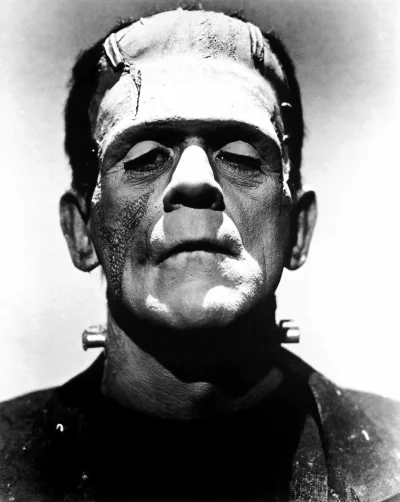
The most influential early version, however, was Frankenstein (1931), produced by Universal Pictures and directed by James Whale.
Boris Karloff played the creature.
The film introduced many elements that have become inseparable from the popular image of Frankenstein:
- The flat-topped head
- Neck bolts
- Heavy boots
- Mechanical movements
- The laboratory filled with electrical equipment
None of these are exactly how Mary Shelley described the creature.
Hollywood had created a new visual language for Frankenstein.
The Bride of Frankenstein
The 1935 sequel, Bride of Frankenstein, is arguably one of the greatest horror films ever made.
Once again directed by James Whale and starring Boris Karloff, the film expands significantly upon Shelley's themes.
The creature desperately wants companionship.
The scientist is forced to confront the consequences of his creation.
The film also introduces the iconic Bride of Frankenstein.
Her appearance has become almost as famous as Karloff's monster.
Interestingly, the bride herself appears only briefly in the original novel. The idea of giving the creature a female counterpart comes from the novel, but Hollywood dramatically expanded the concept.
Frankenstein in Popular Culture
Over the twentieth century, Frankenstein became much more than a literary character.
The creature appeared in:
- Horror films
- Comedy
- Television
- Cartoons
- Comics
- Children's books
- Toys
- Advertising
- Science fiction
- Halloween imagery
The character has been portrayed both as a terrifying monster and as a tragic victim.
The famous Frankenstein's monster became an archetype.
Even people who have never read Shelley's novel recognize the basic concept:
A scientist creates life, and the creation turns against its creator.
That basic formula has been reproduced endlessly.
Frankenstein and Science Fiction
Perhaps the most important legacy of Frankenstein is its role in the development of science fiction.
There is considerable debate over which book should be called the first science-fiction novel.
But Frankenstein is unquestionably one of the earliest major works to use scientific or technological speculation as the mechanism for a fictional story.
Earlier literature contained supernatural and fantastic stories.
What makes Frankenstein different is that Victor's creation is connected to contemporary scientific ideas.
Shelley was writing during a period of extraordinary scientific excitement.
Scientists were investigating:
- Electricity
- Anatomy
- Chemistry
- Physiology
- Galvanism
- The nature of life
Experiments with electricity and dead tissue were particularly relevant.
The Italian scientist Luigi Galvani had demonstrated that electrical stimulation could cause muscles to contract.
His nephew, Giovanni Aldini, famously conducted demonstrations involving electrical stimulation of corpses.
Mary Shelley was familiar with these ideas.
She transformed them into fiction.
The result was revolutionary.
The Frankenstein Formula
One of the most influential ideas in the novel is that the fantastic event doesn't happen because of magic.
It happens because of human knowledge.
Victor doesn't summon a demon.
He doesn't discover a magical artifact.
He uses scientific knowledge to create something that shouldn't exist.
That became one of the defining characteristics of science fiction.
The genre repeatedly asks:
What if technology allowed us to do something that we currently cannot do?
Mary Shelley was one of the first major writers to make that question the central mechanism of a novel.
Frankenstein's Descendants
The influence of Frankenstein can be seen throughout science fiction.
Consider stories involving:
- Artificial intelligence
- Robots
- Cloning
- Genetic engineering
- Biotechnology
- Artificial life
- Cybernetics
- Transhumanism
- Autonomous machines
Again and again, science-fiction writers return to the Frankenstein problem:
If we create something new, will we be able to control it?
The robot rebellion.
The artificial intelligence that surpasses its creators.
The genetically engineered organism that escapes containment.
The cloned human being who demands recognition.
The computer system that becomes self-aware.
These are all variations on a question Mary Shelley asked more than 200 years ago.
Frankenstein and Artificial Intelligence
The comparison with artificial intelligence is particularly striking.
Victor creates an intelligent being.
He does not prepare society to deal with it.
He does not educate it.
He does not establish a relationship with it.
And he does not take responsibility for its existence.
This has obvious parallels with modern debates over AI.
The fundamental question is not simply:
Can we create an intelligent machine?
It is:
What responsibilities do creators have toward the systems they create, and what happens if those systems develop goals or capabilities that their creators did not anticipate?
That is a profoundly Frankensteinian question.
Frankenstein as a Story About the Creator
There is another important insight in Shelley's novel.
The real horror may not be the monster.
It may be the creator.
Victor's tragedy begins with a failure of responsibility.
He wants the glory of discovering the secret of life but does not want the responsibility that follows.
This makes Frankenstein different from many conventional monster stories.
The creature is terrifying.
But Victor is responsible for bringing him into existence.
The novel therefore refuses to provide a simple division between good and evil.
Why Frankenstein Has Survived
Why has Frankenstein remained popular for more than two centuries?
Because the basic question never becomes obsolete.
Every generation develops new technologies.
Every generation discovers new ways to manipulate nature.
And every generation has to ask:
Just because we can do something, does that mean we should?
Mary Shelley asked that question in 1818 in the context of electricity, anatomy, and the nature of life.
Later generations applied it to nuclear weapons, genetic engineering, cloning, artificial intelligence, robotics, and biotechnology.
The technology changes.
The question remains.
Conclusion
Mary Shelley's Frankenstein began as a Gothic novel imagined by an eighteen-year-old woman during a remarkable summer on Lake Geneva.
It became something much larger.
The novel explored the dangers of unchecked ambition, the responsibilities of creators, the consequences of social rejection, the nature of humanity, and the potentially destructive consequences of scientific discovery without moral responsibility.
Its immediate reception was mixed, but the story quickly entered popular culture through stage adaptations.
The twentieth century transformed the creature into one of the world's most recognizable fictional characters, particularly through Boris Karloff's portrayal in the 1931 Universal film and its 1935 sequel.
But the most important legacy of Frankenstein may not be in horror at all.
It lies in science fiction.
Mary Shelley demonstrated that scientific ideas could provide the foundation for imaginative fiction about the future and about the consequences of technological progress.
Her central question has been repeated by generations of writers:
What happens when humanity creates something that it does not understand—and cannot control?
That is why Frankenstein remains relevant.
It is not simply a story about a monster.
It is a story about human beings confronting the consequences of their own creations.
And that is a problem that has become increasingly important with every passing generation.
Comments
Post a Comment